
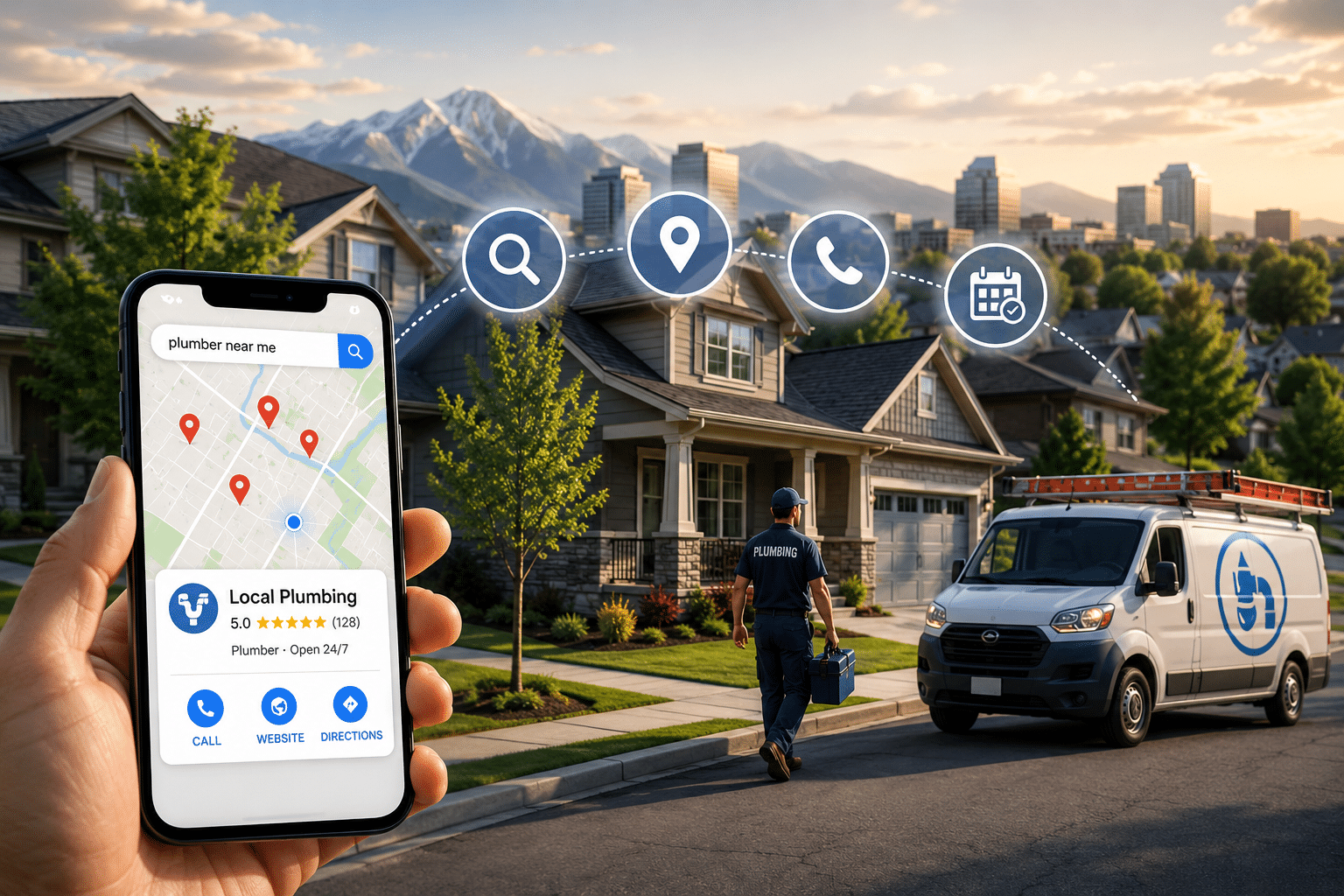
Local SEO for home services is one of the most important foundations for generating consistent leads from Google.
When homeowners search for help, they are usually not looking for a general contractor directory or a broad explanation of a service. They are looking for a company that solves a specific problem in a specific location.
That is why local SEO for home service companies should be built around two things:
The services you provide and the areas you serve.
A homeowner with an urgent issue does not usually search for broad terms like “contractor” or “home service company.” Their search is much more specific, practical, and local.
They may search for:
- Emergency plumber near me
- AC repair in Salt Lake City
- Roof replacement in Provo
- Electrician in Lehi
- House cleaning service in Sandy
- Window cleaning near me
- Furnace repair near me
- Drain cleaning in Park City
- Landscaping company in Draper
- Painting contractor in Ogden
These searches reveal intent. The homeowner already has a problem, already understands they may need help, and is actively looking for a provider nearby.
Your website should make it easy for Google and potential customers to understand exactly what you do, where you do it, and why your company is the right choice.
Your Website Should Clearly Explain What You Do
A common mistake in home service marketing is relying on one general service page to explain everything.
For example, an HVAC company may have one page called “HVAC Services” and expect that page to rank for air conditioning repair, furnace installation, emergency HVAC service, indoor air quality, maintenance plans, heat pump repair, and commercial HVAC.
That is usually too much for one page to accomplish well.
Each important service should have its own dedicated page. A specific service page gives you more room to explain the customer’s problem, your solution, your process, your service area, and the next step.
For example, an HVAC company may need separate pages for:
- AC repair
- AC installation
- Furnace repair
- Furnace installation
- HVAC maintenance
- Emergency HVAC service
- Heat pump repair
- Indoor air quality
- Ductwork services
A plumbing company may need pages for:
- Emergency plumbing
- Drain cleaning
- Water heater repair
- Water heater installation
- Sewer line repair
- Leak detection
- Toilet repair
- Garbage disposal repair
- Pipe replacement
A roofing company may need pages for:
- Roof repair
- Roof replacement
- Storm damage repair
- Roof inspection
- Emergency roof repair
- Metal roofing
- Asphalt shingle roofing
- Commercial roofing
This structure helps Google understand the relevance of each page. It also helps homeowners land on a page that matches what they searched for.
Someone searching for “emergency roof repair near me” should not have to dig through a general roofing page to figure out whether your company handles urgent roof leaks.
They should land on a page that immediately confirms:
“Yes, we provide emergency roof repair in your area. Here is how we help. Here is how to contact us.”
Your Website Should Show Where You Work
Local SEO is not only about services. It is also about location.
Most home service companies serve a defined geographic area. That may include one main city, several nearby suburbs, a county, or a group of service-area communities.
Your website should make those locations clear.
This can be done through:
- A service area page
- City-specific landing pages
- Location mentions within service pages
- Local project examples
- Internal links between services and locations
- Consistent business information
- Google Business Profile alignment
For example, if your company serves Salt Lake City, Provo, Lehi, Sandy, Draper, and Park City, your website should not hide that information in one small footer line.
Those locations should be part of the structure of the site.
However, this needs to be done carefully.
Avoid Thin, Duplicate City Pages
Many companies try to improve local SEO by creating dozens of city pages that are nearly identical.
For example:
“Plumbing services in City A”
“Plumbing services in City B”
“Plumbing services in City C”
If the only real difference between those pages is the city name, the content is not very useful.
Useful city pages should provide real value. They should explain the service in the context of that location, the types of customers served, common local needs, nearby service coverage, examples of work when available, and clear next steps.
A strong local page may include:
- The specific services offered in that city
- Common problems homeowners in that area experience
- Neighborhoods or nearby communities served
- Why the company is a good fit for that location
- Reviews or project examples from the area
- Photos of local work, when available
- Clear calls to action
- Internal links to related service pages
The goal is not to create pages just for search engines. The goal is to create pages that help homeowners quickly understand whether your company can help them in their area.

Service Pages and Location Pages Should Work Together
The best local SEO structure connects services and locations in a way that feels natural.
A service page explains what you do.
A location page explains where you do it.
Together, they help Google and customers understand the complete picture.
For example, a plumbing company may have a main page for “Water Heater Repair” and a city page for “Plumbing Services in Lehi.”
The water heater page can explain the service in detail, while the Lehi page can mention that water heater repair is one of the services available in that city and link to the dedicated water heater repair page.
This type of internal linking helps organize the site.
It also helps users move from a broad location page to a specific service page, or from a service page to a relevant service area.
Match the Page to the Search Intent
Every local SEO page should be built around search intent.
Search intent means the reason behind the search.
A homeowner searching for “AC repair near me” probably needs fast help. The page should focus on symptoms, response time, service area, trust, and how to request service.
A homeowner searching for “how often should I replace my roof” may still be in the research stage. That query may be better served by a blog post or educational guide.
A homeowner searching for “roof replacement contractor in Provo” is much closer to hiring. That search should lead to a page that explains roof replacement services, local experience, estimates, materials, trust signals, and next steps.
Not every keyword belongs on the same type of page.
In home service marketing, your website should usually include a mix of:
- Core service pages
- Service-area pages
- Blog posts
- FAQ content
- Comparison content
- Seasonal service content
- Emergency service pages
- Conversion-focused landing pages
Each page should have a clear job.
Make the Next Step Obvious
Local SEO should not only generate traffic. It should generate action.
A service page that ranks well but does not convert visitors into calls or quote requests is not doing its full job.
Every important service and location page should make the next step obvious.
That may include:
- A visible phone number
- A “Request a Quote” button
- A short contact form
- Click-to-call buttons on mobile
- Trust badges
- Customer reviews
- Service guarantees
- Financing information, when relevant
- Emergency availability, when applicable
- Clear service area confirmation
Homeowners should not have to work hard to contact your company.
If the page answers their question and builds trust, the call to action should be right there when they are ready.
Use Local Content to Build Authority
Local SEO also benefits from useful content that answers real customer questions.
This is where blog posts, guides, and educational content can support your service pages.
For example, a home service company can create content around:
- Common seasonal problems
- Maintenance tips
- Cost factors
- Warning signs
- Service comparisons
- Emergency situations
- Local climate-related issues
- Questions customers ask before booking
An HVAC company could publish content about preparing an AC system before summer, signs a furnace may need repair, or whether a heat pump makes sense in a certain climate.
A roofing company could publish content about storm damage, roof inspection checklists, roof replacement timelines, and how to know if a leak requires urgent repair.
A plumbing company could publish content about drain clogs, water heater issues, leak detection, frozen pipes, and sewer line warning signs.
This content helps the company become more useful and visible. It can also support AI-powered search experiences because the website provides clear, specific answers to common questions.
The more clearly your website explains your services, locations, process, and expertise, the easier it becomes for search engines and AI systems to understand what your company should be associated with.
Keep Your Business Information Consistent
Local SEO depends on trust and consistency.
Your business name, address, phone number, website, hours, service areas, and categories should be consistent across your website, Google Business Profile, directories, and other local listings.
Inconsistent information can create confusion for both customers and search engines.
Review your business information across:
- Website footer
- Contact page
- Google Business Profile
- Local directories
- Social profiles
- Industry platforms
- Review websites
- Map listings
Even small issues can hurt the user experience.
If your Google Business Profile says you are open, but your website shows different hours, a homeowner may hesitate.
If your phone number is different across listings, calls may be misdirected.
If your service area is unclear, potential customers may not know whether you can help.
Clarity builds trust.
Technical Performance Matters Too
Local SEO is not only about content.
Your website also needs to perform well.
A slow, confusing, or technically weak website can reduce both rankings and conversions.
Important technical factors include:
- Fast loading speed
- Mobile-friendly design
- Clear navigation
- Secure HTTPS connection
- Proper heading structure
- Clean URL structure
- Optimized images
- Accessible content
- Working forms
- Clickable phone numbers
- No broken links
- Schema markup when appropriate
Most homeowners searching for urgent home services are using a mobile device.
If your website loads slowly or makes it difficult to call, you may lose the lead before they even understand what you offer.
Local SEO Should Support Real Business Growth
The goal of local SEO is not simply to get more website visitors.
The goal is to help the right people find the right service in the right location and take the next step.
Strong local SEO connects:
- Service relevance
- Location relevance
- Trust
- Technical performance
- Helpful content
- Clear conversion paths
When these elements work together, your website becomes more than an online brochure. It becomes a local demand engine.
A homeowner searches for a specific service. Google understands that your company offers that service in that location. The visitor lands on a relevant page. The page builds trust. The call to action is clear. The company receives a qualified call or quote request.
That is the role local SEO should play in home service lead generation.
It should help your business become easier to find, easier to understand, and easier to contact.
Related Readings.
View All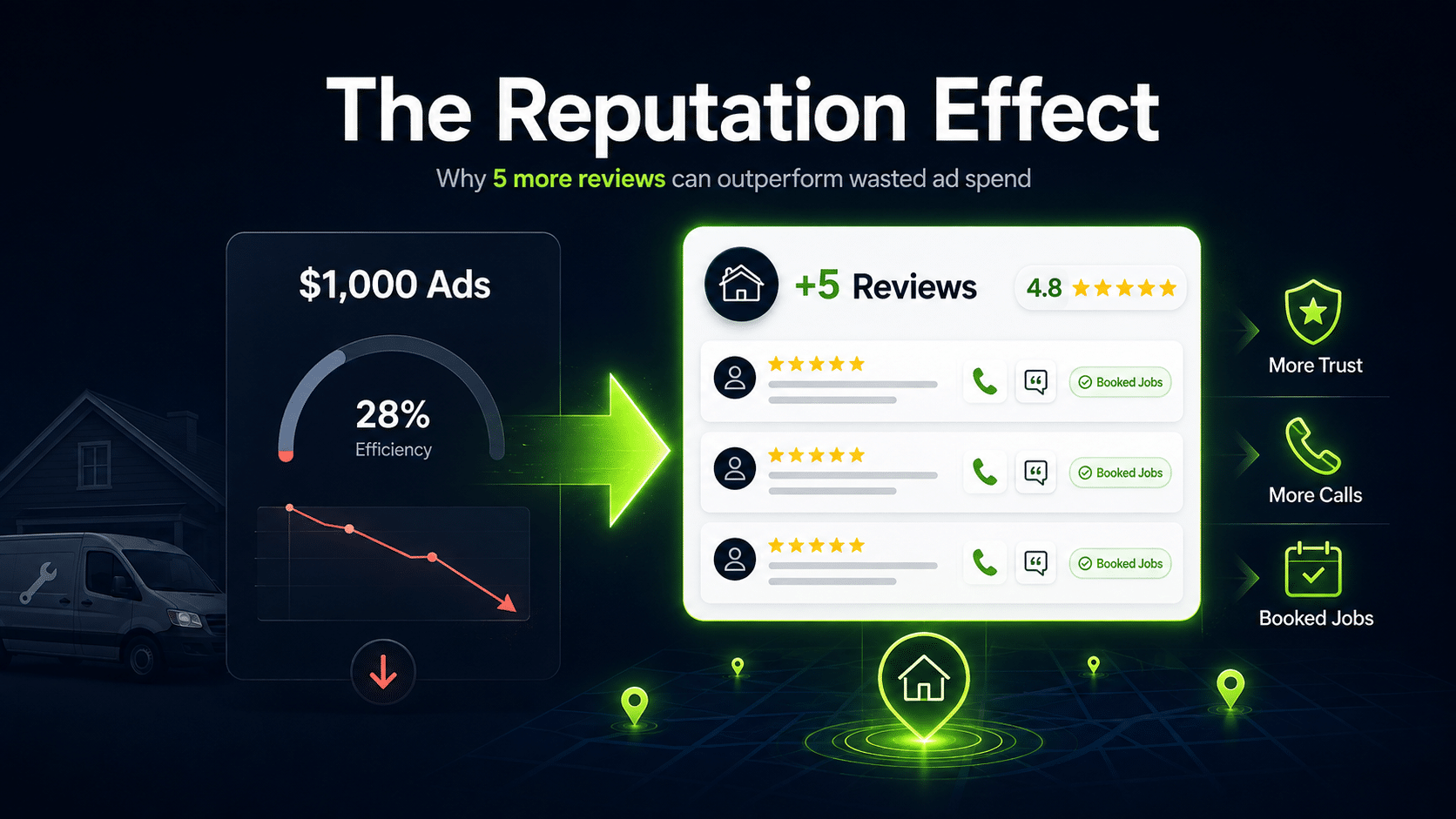
The Reputation Effect: How 5 More Google Reviews Can Outperform $1,000 in Ad Spend
Most home service companies know exactly how much they spend on advertising every month. $1,000. $3,000. $10,000. Maybe considerably more. Ask the same owner how many new Google reviews the...
Read Story
Prompt Farming: The New Keyword Research for Home Services
Here’s a scenario that will change how you think about content forever. Same problem. Same homeowner. Same purchase intent. But watch the difference in how they ask. On Google, they...
Read Story