
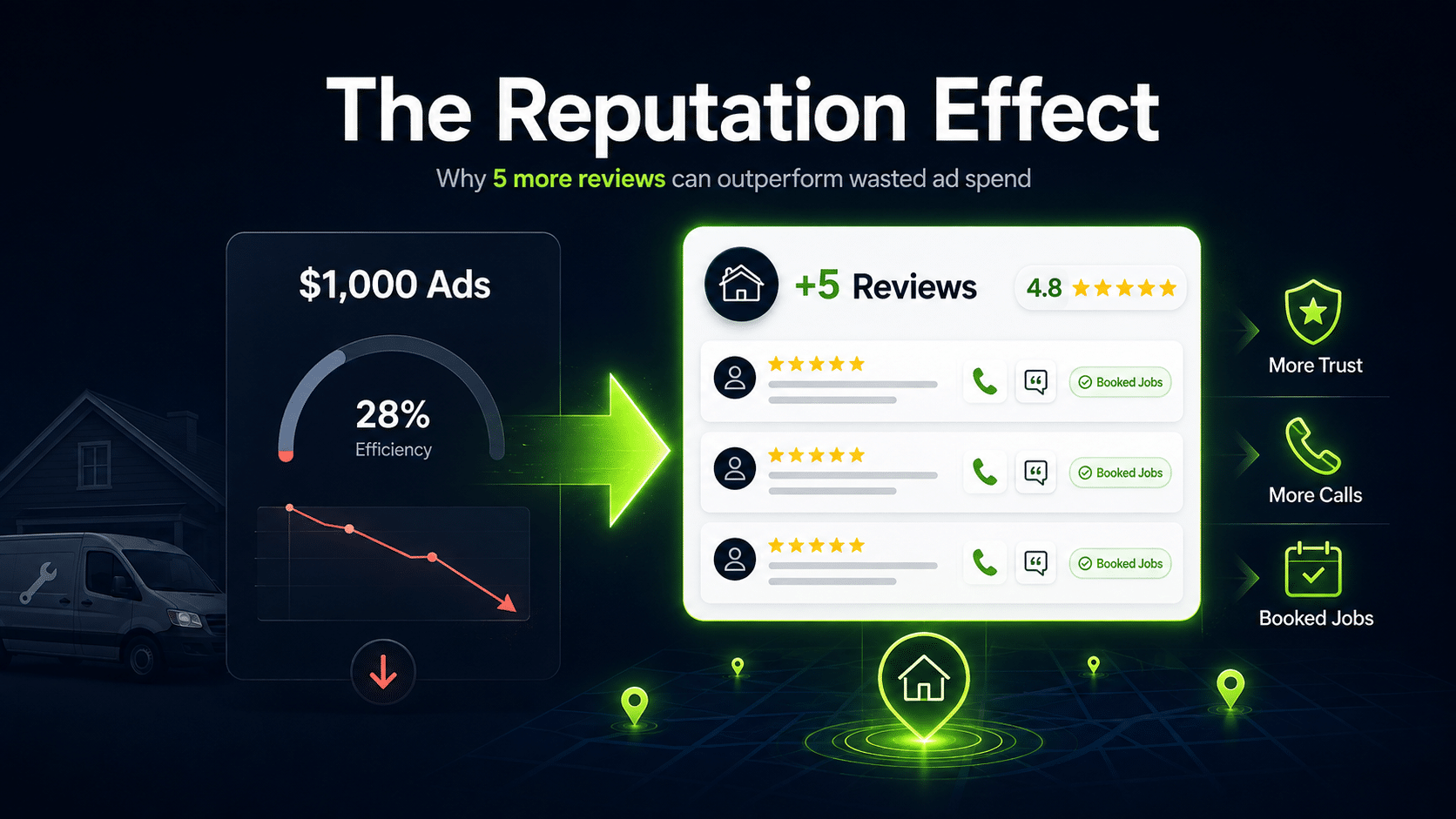
Most home service companies know exactly how much they spend on advertising every month.
$1,000.
$3,000.
$10,000.
Maybe considerably more.
Ask the same owner how many new Google reviews the company generated last month, though, and the answer is often less precise.
That is a problem.
Because while advertising helps your business get seen, your reputation often determines whether the homeowner actually chooses you.
And that creates an important question:
Before putting another $1,000 into ads, could five more recent Google reviews create a bigger impact on your growth?
In the right situation, absolutely.
Not because reviews magically replace advertising.
Because reviews can make almost everything you are already doing in marketing work harder.
Ads Buy Attention. Reviews Build Trust.
Imagine a homeowner searching for:
“AC repair near me.”
Your Google Ads campaign works.
Your company appears.
The homeowner clicks.
Great.
But your competitor is sitting right beside you with a 4.8-star rating, a steady stream of recent reviews, detailed customer experiences, and visible evidence that homeowners in the area trust them.
Your company has a 4.3-star rating and the last review came five months ago.
Who gets the call?
The advertising did its job. It generated visibility.
The reputation profile helped determine what happened next.
That distinction is critical.
A company can keep increasing its advertising budget to generate more traffic, but if homeowners do not trust what they find after discovering the business, more traffic simply means more opportunities to lose the customer.
That is why reviews should not be treated as a vanity metric.
They are part of your conversion system.
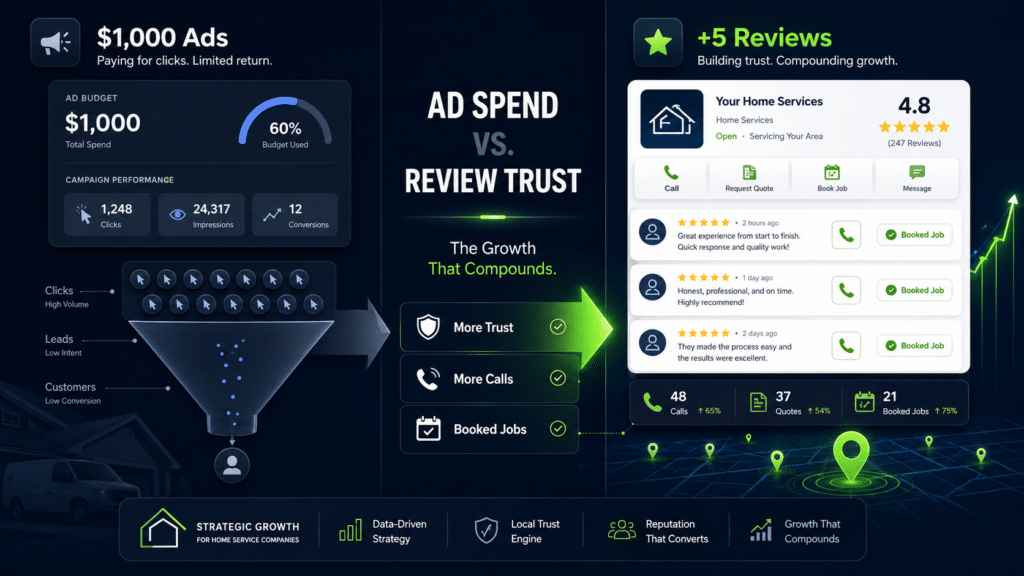
Reviews Are a Growth Multiplier
The value of a review goes beyond the person who originally wrote it.
A review can influence the next homeowner.
And the one after that.
And the next one after that.
It can affect someone who found you through Google Ads.
Someone who discovered you organically.
Someone who saw your truck in the neighborhood.
Someone who received your name from a friend.
Someone who found your Google Business Profile while comparing contractors.
That is why we think about reputation differently.
Reviews do not just generate trust. They multiply the value of visibility you already have.
Your SEO puts you in the search.
Your PPC campaign puts you in front of the customer.
Your Google Business Profile provides information.
Your reviews provide proof.
And proof is often what turns visibility into action.
Google Reviews Can Influence Local Visibility Too
Reviews are not only about consumer psychology.
They also play a role in local search.
Google explains that local results are primarily determined by relevance, distance, and prominence. As part of prominence, Google notes that review volume and positive ratings can contribute to stronger local ranking.
That means reputation can potentially influence two important parts of your funnel at once:
Visibility and conversion.
More relevant local visibility gives homeowners another opportunity to discover you.
A stronger reputation gives those homeowners another reason to choose you.
For home service companies competing market by market, that combination matters.
Because you are rarely competing against every plumber, HVAC contractor, electrician, roofer, or cleaning company in the country.
You are competing against the handful of companies the homeowner sees when they search in your service area.
Homeowners Are Looking at Reviews
Reviews have become part of the normal buying process for local services.
According to research referenced in BrightLocal’s Local Consumer Review Survey, the vast majority of consumers consult reviews when evaluating local businesses.
And consumers are becoming increasingly selective.
Star rating matters.
Review volume matters.
The content of those reviews matters.
But there is another factor many home service companies underestimate:
Recency.
Think about it from the homeowner’s perspective.
A company might have hundreds of reviews.
Great.
But if the most recent feedback was written eight months ago, there is still an unanswered question:
“Are they still this good?”
A recent review answers that question.
It tells homeowners that people are hiring you now.
That your crews are working.
That customers are having positive experiences.
That your reputation is alive, not historical.
The Real Battle Is Often Won After the Click
This is where the relationship between advertising and reputation becomes especially important.
Suppose two companies spend the exact same amount on Google Ads.
Both receive 100 qualified visitors.
Company A has a weak review profile.
Company B has a strong rating, recent reviews, and consistent customer feedback.
Even if their advertising performance is identical at the click level, the customer experiences after that click are completely different.
Company B is giving homeowners more reasons to trust the business.
That can influence:
More trust → more calls → more quotes → more booked jobs.
So the question is not simply:
Should we invest in ads or reviews?
The better question is:
Are our reviews helping our advertising convert?
Because spending more money to amplify a weak reputation is rarely the smartest first move.
Sometimes you do not need more traffic.
You need to convert more of the traffic you already have.
Why 5 Reviews Can Matter More Than Another $1,000
The headline of this article is intentionally provocative.
There is no universal equation where:
5 reviews = $1,000 in ad spend.
Different markets, services, ratings, competition levels, advertising costs, and customer behaviors produce different results.
The strategic lesson is more important than the literal number.
Another $1,000 in advertising buys another period of exposure.
Stop paying, and that additional exposure stops.
Five legitimate new reviews become part of your reputation profile.
They can influence future customers every time they encounter your business.
And when those five reviews are part of a consistent system that generates five more next month, and five more after that, something starts happening:
Your reputation compounds.
Instead of constantly renting attention, you are building an asset around the business.
Introducing Review Velocity
The biggest mistake companies make with review generation is relying on memory.
A technician remembers to ask one customer.
The office manager sends a link occasionally.
Someone launches an email campaign every few months.
Then everyone gets busy.
Review generation disappears.
A better approach is to build what we call Review Velocity: a consistent system that turns successful customer experiences into a steady flow of honest feedback.
Here is what that can look like.
1. Ask at the Moment of Highest Satisfaction
Timing matters.
If the repair is finished, the issue is solved, the system is working again, and the homeowner is happy, that is the moment to ask.
Not seven days later.
Not during a random marketing campaign.
Right after you have delivered the value.
2. Make the Request Human
Automation helps.
But the technician or team member who just solved the customer’s problem has something automation does not:
Context.
A simple request can work:
“Glad we got everything taken care of. Reviews really help local homeowners feel confident choosing us. Would you mind if I sent you a quick link to leave an honest Google review?”
No pressure.
No complicated script.
Just a natural extension of a positive customer experience.
3. Send the Direct Review Link
Remove friction.
The customer should not need to search for your company, locate the right profile, find the review section, and figure out what to do.
Send them directly where they need to go.
A simple SMS can say:
“Hi [Name], thanks again for choosing [Company]. If you have a moment, we’d appreciate an honest review about your experience. It helps other homeowners in the area know what to expect from our team: [Review Link]”
4. Follow Up Once
People get distracted.
A homeowner might genuinely intend to review you and simply forget.
One polite reminder after a couple of days can help.
Do not turn a review request into a three-week nurture campaign.
One reminder is enough.
5. Respond to Reviews
Your response is not only for the person who left the review.
Future customers can read it too.
Responding demonstrates that the company is active, attentive, and engaged with its customers.
It also gives you an opportunity to naturally reinforce what your company does and where it operates.
6. Use Reviews Beyond Google
A strong review does not have to stay trapped inside your Google Business Profile.
Customer feedback can become proof throughout your marketing ecosystem.
Use appropriate reviews across:
- Service pages
- Location pages
- Landing pages
- Sales materials
- Follow-up emails
- Social content
- Advertising creative
If a customer has already explained why your business was the right choice, let that proof help the next customer make the same decision.
More Traffic Is Not Always the Answer
Marketing teams love acquisition.
More clicks.
More impressions.
More leads.
More traffic.
But growth does not happen because a dashboard moves upward.
It happens when more of the right people choose your company.
That is why one of the first questions we ask when evaluating a home service company’s marketing is not simply:
“How can we generate more traffic?”
We also want to know:
“What happens after people find you?”
Does your business look established?
Does your Google Business Profile inspire confidence?
Are customers reviewing you consistently?
Are those reviews recent?
Are you responding?
Does the reputation visible online match the quality of service you actually deliver?
If the answer is no, increasing the ad budget may simply send more homeowners into a conversion problem that already exists.
Reputation and Paid Media Should Work Together
This is not an argument against Google Ads.
Paid search can be extremely valuable for home service companies because it allows you to capture demand when homeowners are actively looking for help.
The opportunity comes from making the two systems support each other.
Ads create visibility.
Reviews create trust.
Local SEO creates discoverability.
Conversion optimization turns attention into action.
When those systems work together, marketing becomes much more efficient.
That is the real Reputation Effect.
Instead of asking how much more money you can put into advertising next month, ask a different question:
How much more valuable could the traffic we already generate become if homeowners trusted us more when they found us?
The answer might start with just five reviews.
And then five more.
And five more after that.
Build Reputation Into Your Growth System
Your Google Business Profile should not be something you check when a negative review arrives.
Your reputation should be actively managed as part of your growth strategy.
At LeadGrowth, we help home service businesses connect Local SEO, Google Business Profile optimization, reputation, paid media, and conversion strategy into one system designed around the metric that actually matters:
Booked jobs.
Before automatically increasing your advertising budget, find out whether your current marketing is leaking opportunities.
See how LeadGrowth builds Local SEO systems that turn search visibility into trust, calls, and booked jobs.
Related Readings.
View All
Prompt Farming: The New Keyword Research for Home Services
Here’s a scenario that will change how you think about content forever. Same problem. Same homeowner. Same purchase intent. But watch the difference in how they ask. On Google, they...
Read Story
Why ChatGPT Recommends Your Competitor – And How to Fix It
Right now, a homeowner in your service area is typing this into ChatGPT: “Our upstairs AC just started blowing warm air and there’s water pooling near the air handler. Should...
Read Story