

Getting more traffic is not the same as getting more booked jobs.
For many home service companies, this is one of the most frustrating parts of marketing. The website may be getting visitors. Google Ads may be producing clicks. Google Business Profile may be generating views. Forms may even be coming in.
But the number of actual booked jobs does not grow the way it should.
That is because the click is not the finish line.
In home service marketing, the real question is not only whether people can find your business. The real question is what happens after they find you.
A homeowner may visit your website, call your business, request a quote, or ask for availability. But if that action is not answered quickly, tracked correctly, qualified properly, and followed up with consistency, the opportunity can disappear before it ever becomes revenue.
That is where many growth leaks happen.
For home service companies, the journey from a website visit to a booked job must be treated as a complete system. When that system works, marketing becomes easier to understand and improve. When it breaks, businesses often blame traffic, ads, or SEO without realizing the real problem is happening after the first click.
This article explains how home service companies lose leads after the click, what each stage of the conversion path should accomplish, and how a Growth Audit can help identify where qualified opportunities are being lost.
Why More Traffic Does Not Always Mean More Jobs
More traffic can help a business grow, but traffic alone does not create revenue.
A homeowner visiting your website is only the beginning of the journey. They still need to understand what you offer, confirm that you serve their location, trust your company, find a clear next step, contact you, receive a response, and move forward with an estimate or booking.
If any of those steps fail, the business may lose the lead.
This is why many home service companies feel confused by their marketing results. They may see more clicks, more impressions, or more website visits, but not enough qualified calls, quote requests, estimates, or booked jobs.
The problem is often not one single channel.
It may be the connection between the channels.
For example, a plumbing company may pay for Google Ads but send traffic to a generic homepage. A roofing company may rank on Google Maps but miss calls during business hours. An HVAC company may receive quote requests but fail to track which campaign generated them. A cleaning company may get inquiries but respond too slowly. An electrician may receive leads but discover many are outside the service area.
In each case, marketing activity is happening, but the system is leaking opportunities.
That is why home service lead conversion requires more than traffic generation. It requires a clear path from visibility to action, from action to qualification, and from qualification to booked work.
The Real Home Service Lead Journey
The home service lead journey can be simplified into five key stages:
Website Visit → Phone Call or Quote Request → Qualified Lead → Estimate → Booked Job
Each stage has a different role.
The website visit creates the opportunity. The call or quote request captures intent. The qualified lead confirms business fit. The estimate moves the customer toward a decision. The booked job turns marketing into revenue.
When these stages are connected, the company can see where leads are coming from, how people are taking action, which opportunities are valuable, and what needs to improve.
When these stages are disconnected, the business is left guessing.
A strong marketing system should answer questions such as:
Which channels are generating real leads?
Which services are producing the best opportunities?
Which locations are converting?
How many calls are being missed?
How quickly is the team responding?
How many leads become estimates?
How many estimates become booked jobs?
Where are potential customers dropping off?
These questions matter because home service marketing is not only about visibility. It is about turning local demand into real business outcomes.

Stage 1 — Website Visit
The first stage is the website visit.
This may come from Google Search, Google Maps, Google Ads, Meta Ads, local SEO, AI search results, a referral, a directory, or a returning customer.
At this point, the visitor is not just a number in analytics. They are a potential customer with a specific problem.
They may need emergency plumbing, AC repair, roof replacement, electrical troubleshooting, house cleaning, landscaping, painting, window washing, or another home service. In many cases, they are comparing multiple companies at the same time.
Your website has only a short window to confirm that your company is relevant.
A strong home service website should quickly answer five questions:
What service do you provide?
Do you serve my area?
Can I trust your company?
How fast can I get help?
What should I do next?
If the visitor cannot answer those questions quickly, they may leave and contact a competitor.
This is why generic websites often underperform. A homepage that says “quality service you can trust” is not enough. The page needs to match the customer’s need.
Someone searching for “emergency plumber near me” should land on a page that clearly talks about emergency plumbing. Someone searching for “AC repair in Salt Lake City” should see AC repair and the relevant service area immediately. Someone looking for “roof replacement in Provo” should not have to click through several pages to understand whether the company handles roof replacement in Provo.
The more specific the visitor’s intent, the more specific the page should be.
What a Strong Website Visit Should Do
A strong website visit should not only inform the visitor. It should move them toward action.
That does not mean pressuring the customer. It means removing confusion.
The page should have a clear headline, a simple explanation of the service, visible contact options, trust signals, service area information, and a direct call to action.
Important elements include:
A clear service-specific headline
A visible phone number
A short quote request form
Mobile click-to-call functionality
Customer reviews or testimonials
Photos of real work, when available
Service area confirmation
Emergency availability, when relevant
Simple navigation
Fast page speed
Trust badges, licenses, or guarantees when appropriate
The visitor should immediately understand that they are in the right place.
If the page is slow, vague, cluttered, or difficult to use on mobile, the company may lose the lead before a call or form ever happens.
Stage 2 — Phone Call or Quote Request
The second stage is the first conversion action.
For most home service companies, this usually happens through a phone call or a quote request form.
This is where a visitor becomes an inquiry.
A phone call often indicates higher urgency. The homeowner wants an answer now. They may need immediate help, a fast estimate, or confirmation that the company can serve their location.
A quote request form may indicate interest with slightly less urgency. The homeowner may be comparing providers, planning a project, or requesting details before making a decision.
Both actions matter.
However, both actions need to be easy and trackable.
If the phone number is hard to find, the business loses calls. If the form is too long, the business loses submissions. If the phone number is not trackable, the business may not know which campaign generated the call. If the form does not pass source data correctly, the marketing report becomes incomplete.
A lead that cannot be tracked is difficult to improve.
This is one of the most common problems in home service marketing. Companies may receive calls and forms, but they do not know which channel, keyword, page, ad, or location produced the opportunity.
Without that visibility, budget decisions become guesswork.
Why Call Tracking Matters
Call tracking is especially important for home service companies because many leads happen over the phone.
A homeowner with an urgent issue may not want to fill out a long form. They want to call and speak with someone.
If phone calls are not tracked properly, a business may underestimate the value of SEO, Google Ads, Google Business Profile, or landing pages.
For example, a campaign may appear to produce few form submissions, but it may actually be generating valuable phone calls. Without call tracking, the business may pause or reduce investment in a channel that is working.
Call tracking can help identify:
Which campaigns generate calls
Which pages drive phone inquiries
Which keywords produce stronger intent
Which locations are more active
How many calls are missed
How long calls last
Which calls become qualified leads
Which calls become estimates or jobs
This does not mean tracking should replace human judgment. It means the business should have enough data to understand what is happening.
Why Form Tracking Matters
Quote request forms also need to be tracked correctly.
A form submission should tell the business more than “someone contacted us.”
It should help answer:
Which page did the lead come from?
Which channel generated the visitor?
Which service did they request?
Which location are they in?
What is the urgency?
Was the lead qualified?
Did the lead become an estimate?
Did the estimate become a booked job?
If forms are not connected to the broader marketing system, the company may collect inquiries without understanding performance.
A strong form should be simple enough to encourage completion, but useful enough to help the team respond effectively.
For many home service businesses, a good quote form asks for the customer’s name, phone number, email, service needed, location, and a brief description of the problem.
The goal is not to create friction. The goal is to collect enough information to respond quickly and appropriately.
Stage 3 — Qualified Lead
The third stage is qualification.
This is where many businesses make a major reporting mistake.
They treat every call or form submission as a lead.
In reality, not every inquiry is a qualified lead.
Some calls are spam. Some are wrong numbers. Some are vendors. Some are job seekers. Some are outside the service area. Some are customers asking about services the company does not provide. Some are price shoppers who are unlikely to move forward. Some are not ready to schedule.
A qualified lead is different.
A qualified lead is someone who needs a service you provide, is located in an area you serve, has a realistic need or project, and has the potential to become a customer.
This distinction matters because marketing should not be judged only by volume.
A campaign that generates 100 poor-quality inquiries may be less valuable than a campaign that generates 25 strong opportunities.
For home service companies, lead quality is often more important than lead quantity.
What Makes a Home Service Lead Qualified?
A qualified home service lead usually has several characteristics.
They need a service the company actually offers. They are located inside the company’s service area. They have a real problem or project. They have a reasonable timeline. They are reachable. They are not clearly outside the company’s target customer profile.
For example, a roofing lead may be qualified if the homeowner needs roof repair, roof replacement, storm damage inspection, or leak repair in a city the company serves.
An HVAC lead may be qualified if the homeowner needs AC repair, furnace repair, system installation, emergency service, maintenance, or indoor air quality support in the correct service area.
A plumbing lead may be qualified if the homeowner needs drain cleaning, leak detection, water heater repair, emergency plumbing, sewer line repair, or fixture replacement in the company’s operating area.
A cleaning lead may be qualified if the customer needs recurring house cleaning, deep cleaning, move-in or move-out cleaning, or another service the company wants to sell.
The more clearly a business defines qualified leads, the easier it becomes to evaluate marketing performance.
Why Lead Quality Review Is Essential
Lead quality review helps home service companies understand whether marketing is attracting the right people.
This can include reviewing calls, form submissions, booked estimates, customer notes, CRM data, and job outcomes.
The goal is to identify patterns.
Are most leads coming from the right locations?
Are they asking for profitable services?
Are they serious buyers?
Are they emergency requests or low-intent inquiries?
Are calls being answered?
Are quote requests being followed up?
Are certain campaigns producing better customers?
Are some pages generating traffic but weak leads?
Without lead quality review, businesses may optimize for the wrong metric.
They may chase cheaper clicks instead of better jobs. They may focus on lead volume instead of revenue potential. They may increase ad spend before fixing qualification problems.
A good marketing system does not simply ask, “How many leads did we get?”
It asks, “How many of those leads were worth pursuing?”
Stage 4 — Estimate
The fourth stage is the estimate.
This is where the opportunity becomes more serious.
Depending on the industry, this stage may be called an estimate, consultation, inspection, service visit, assessment, or quote appointment.
For many home service companies, the estimate is where marketing and sales overlap.
The customer has already shown interest. Now the company needs to respond clearly, schedule efficiently, explain the process, and create confidence.
This stage can make or break the opportunity.
A lead may be qualified, but if the company takes too long to schedule, communicates poorly, or fails to explain the next step, the customer may choose a competitor.
The estimate stage should feel like a natural continuation of the marketing experience.
If the ad promised emergency service, the response should feel urgent. If the landing page emphasized professionalism, the phone conversation should feel organized. If the website highlighted local experience, the team should be ready to discuss the customer’s area and service need.
Consistency builds trust.
Common Problems at the Estimate Stage
Many leads are lost between the first inquiry and the estimate.
Common problems include:
The team does not respond fast enough
The customer is not contacted multiple times
The scheduling process is unclear
The customer does not understand what happens next
The company does not confirm the appointment
The estimate is delayed
The team does not explain pricing factors clearly
The customer is not reminded before the appointment
The lead is not updated in the CRM
The business cannot see which leads became estimates
These issues may not look like marketing problems at first. But they affect marketing performance directly.
If a company spends money to generate leads but does not convert them into estimates, the marketing investment is not being fully used.
That is why the estimate stage should be part of the growth conversation.
Stage 5 — Booked Job
The fifth stage is the booked job.
This is the real business outcome.
A booked job means the homeowner found the company, trusted the message, took action, qualified as a potential customer, received a next step, and committed to the service.
This is where marketing becomes revenue.
A business should not only measure clicks, impressions, rankings, website visits, and form submissions. Those metrics are useful, but they are not the final goal.
The final goal is booked work.
For a home service company, booked jobs are what keep technicians busy, improve revenue predictability, justify marketing investment, and create the foundation for long-term growth.
This is why tracking should ideally connect marketing activity to business outcomes.
At minimum, a company should know which channels generate calls and forms. A more mature system should also understand which leads become estimates and which estimates become booked jobs.
That visibility makes marketing decisions much stronger.
The Most Common Growth Leaks After the Click
Most home service companies do not lose leads because of one big failure.
They lose leads through small leaks across the journey.
A growth leak is any point where a potential customer shows interest but does not successfully move to the next stage.
The most common leaks include missed calls, untracked forms, slow response, unqualified leads, and no follow-up.
Each one can quietly reduce revenue.
Growth Leak 1 — Missed Calls
Missed calls are one of the most expensive leaks in home service marketing.
When a homeowner calls a service business, especially for urgent work, they may not wait. If nobody answers, they often call the next company.
This is especially true for emergency plumbing, HVAC repair, electrical issues, roof leaks, and other time-sensitive services.
A missed call is not just a missed conversation. It may be a missed job.
Businesses should review how often calls are missed, when they are missed, and whether someone follows up quickly.
Important questions include:
Are calls being answered during business hours?
Are calls being missed during lunch breaks or after hours?
Is there a voicemail system?
Are missed calls returned quickly?
Does the team know which calls came from marketing campaigns?
Are urgent calls prioritized?
If a business is investing in SEO or paid ads but missing calls, increasing traffic may only increase wasted opportunity.
Growth Leak 2 — Form Not Tracked
A form submission should create a clear record.
The business should know who submitted it, what service they need, where they are located, when they submitted it, and which source generated the visit.
If the form is not tracked correctly, the business may lose important marketing intelligence.
For example, a company may receive a quote request but not know whether it came from Google Ads, organic search, Google Maps, Facebook, or a referral page.
This makes it difficult to know what is working.
Form tracking should help connect the inquiry to the page, channel, campaign, and service whenever possible.
Without that connection, the business may keep spending money without understanding which efforts produce real opportunities.
Growth Leak 3 — Slow Response
Speed matters in home services.
When homeowners request help, they often contact more than one company. The business that responds first, communicates clearly, and makes scheduling easy has a major advantage.
A slow response can make a strong lead go cold.
Even if the customer still needs the service, the moment of urgency may pass. They may find another provider. They may lose confidence. They may assume the company is too busy or unorganized.
Fast response does not mean rushing the customer. It means acknowledging the request quickly and giving them a clear next step.
This can include:
Calling back promptly
Sending a confirmation message
Offering appointment windows
Clarifying the service need
Confirming the location
Explaining what happens next
Following up if the customer does not answer
A fast, professional response can turn more inquiries into estimates and booked jobs.
Growth Leak 4 — Lead Not Qualified
Not every lead is a fit.
A business may receive inquiries from outside its service area, from people looking for services it does not provide, or from customers who are unlikely to move forward.
This is normal.
The problem happens when the business does not separate qualified leads from unqualified inquiries.
If every inquiry is counted equally, the marketing report becomes misleading.
A campaign may appear successful because it generated many leads, but if those leads are not a fit, the business may waste time, budget, and team attention.
Lead qualification helps the company understand which marketing channels produce real opportunities.
It also helps the team prioritize better.
Growth Leak 5 — No Follow-Up
Some leads do not convert immediately.
That does not mean they are worthless.
A homeowner may need to discuss the project with a spouse, compare estimates, check timing, review budget, or wait for availability.
If the company never follows up, the lead may disappear.
Follow-up is especially important for higher-value services such as roof replacement, HVAC installation, remodeling-related work, landscaping projects, painting, and other estimate-based services.
A simple follow-up process can help recover opportunities that would otherwise be lost.
This may include:
A same-day follow-up
A next-day follow-up
A reminder before the estimate
A post-estimate follow-up
A quote review message
A reactivation message for older leads
No follow-up usually means the business is relying on the customer to do all the work.
A stronger system keeps the opportunity moving.

How Tracking Reveals Where Leads Are Being Lost
Tracking helps a business see the full journey.
Without tracking, marketing problems are often based on opinion.
One person may think the ads are not working. Another may think the website is the issue. Another may believe the team needs more leads. Another may think calls are being missed.
Tracking turns those assumptions into a clearer picture.
A strong tracking setup can show:
How many people visited the website
Which pages they visited
Which channels produced traffic
Which visitors became calls or forms
Which calls were answered
Which forms were submitted
Which leads were qualified
Which leads became estimates
Which estimates became booked jobs
The goal is not to create complex reports for the sake of reporting.
The goal is to understand where the business is losing money.
If traffic is strong but calls are weak, the website may need conversion improvements. If calls are strong but estimates are low, response or qualification may be the problem. If estimates are strong but booked jobs are weak, the sales process may need attention. If booked jobs are strong from one channel and weak from another, budget may need to shift.
Tracking makes better decisions possible.
Why Follow-Up Should Be Part of Marketing
Many companies treat follow-up as a sales or operations issue.
But follow-up has a direct impact on marketing performance.
If marketing generates an inquiry and the business does not respond properly, the marketing system will appear weaker than it really is.
This is why follow-up should be part of the growth conversation.
Marketing does not end when the lead is submitted. It continues through the first response, the estimate, the reminder, the quote review, and the booking process.
For home service companies, follow-up should be simple, fast, and consistent.
The business does not always need a complicated system. It needs a process that makes sure no serious opportunity is forgotten.
A basic follow-up process should define:
Who responds to new leads
How quickly they respond
What happens if the customer does not answer
How many follow-up attempts are made
How estimates are confirmed
How quotes are followed up
How lead status is updated
How booked jobs are reported back to marketing
This creates accountability.
It also helps the business understand whether the problem is lead generation or lead handling.
How Faster Response Improves Lead Conversion
In home service industries, timing can decide who wins the job.
A homeowner with a leaking pipe, broken AC, electrical issue, roof leak, or urgent cleaning need is often looking for the fastest reliable option.
If your company responds quickly, you reduce uncertainty. You show professionalism. You make it easier for the customer to choose you.
Speed is not only about answering the phone. It is about creating momentum.
Fast response can include:
Immediate call answering
Quick callback for missed calls
Automatic form confirmation
Fast human follow-up
Clear appointment scheduling
Simple quote request handling
Timely estimate reminders
Post-estimate follow-up
The easier the process feels, the more likely the customer is to continue.
A slow or confusing response creates doubt.
And in home services, doubt often sends the customer back to Google.
Why Landing Pages Affect the Entire Journey
Landing pages are not only about design.
They influence the quality and speed of the entire lead journey.
A strong landing page can pre-qualify customers before they call or submit a form. It can clarify the service, location, urgency, process, and next step.
For example, a strong emergency plumbing landing page can explain that the company handles urgent plumbing problems, list the service area, show trust signals, display a phone number, and invite the homeowner to call now.
That creates a better call.
The customer knows they are contacting the right type of company. The team receives a more relevant inquiry. The path to scheduling becomes clearer.
A weak landing page creates the opposite effect.
If the page is generic, vague, or disconnected from the ad or search query, the visitor may hesitate. If they do contact the business, they may be less informed and harder to qualify.
Better landing pages do not only increase conversions. They can improve lead quality.
Why Lead Volume Alone Can Be Misleading
Many home service companies ask for more leads.
That is understandable.
But more leads are not always better if the system cannot handle them or if the leads are not qualified.
Lead volume without qualification can create noise. It can overwhelm the team, inflate reporting, waste ad spend, and make marketing look better than it actually is.
A more useful goal is qualified lead growth.
Qualified lead growth means the business is attracting more of the right opportunities, not just more inquiries.
This requires alignment between SEO, paid media, landing pages, tracking, and follow-up.
For example, an HVAC company may not want every possible HVAC-related click. It may want high-intent searches for profitable services in specific service areas.
A roofing company may not want low-quality traffic from people looking for DIY roof repair tips if the goal is replacement estimates.
A cleaning company may not want one-time low-value inquiries if the business model depends on recurring customers.
A landscaping company may not want leads outside its ideal project size.
Marketing should be connected to the business model, not just the traffic report.
How a Growth Audit Finds the Leaks
A Growth Audit helps identify where the journey from click to booked job is breaking down.
It looks beyond surface-level metrics and reviews the full path a potential customer takes.
Instead of only asking, “Are we getting traffic?” a Growth Audit asks:
Are the right people finding the business?
Are they landing on the right pages?
Do those pages match their search intent?
Are phone calls easy to make?
Are quote forms simple and trackable?
Are calls being answered?
Are missed calls followed up?
Are leads being qualified?
Are estimates being scheduled?
Are booked jobs being connected back to marketing activity?
This type of audit can reveal problems that are not obvious in a basic report.
For example, a campaign may look weak because it has a low form conversion rate. But the audit may show that it generates strong phone calls. Another campaign may look successful because it generates many leads, but the audit may show that most are outside the service area. A landing page may get traffic, but the audit may reveal that the call to action is unclear on mobile.
The purpose of a Growth Audit is to create clarity.
It helps the business understand what should be fixed first.
What Home Service Companies Should Measure
A stronger home service marketing system should measure more than clicks and impressions.
Important metrics include:
Website visits
Traffic by channel
Landing page conversion rate
Phone calls
Missed calls
Form submissions
Cost per lead
Qualified leads
Cost per qualified lead
Estimates scheduled
Booked jobs
Lead response time
Service area performance
Service category performance
Conversion rate from lead to estimate
Conversion rate from estimate to booked job
Not every company needs a complex setup on day one.
But every company should move toward better visibility.
The better the data, the easier it becomes to improve the system.
How to Strengthen the Path From Click to Booked Job
Improving the path from website visit to booked job does not always require a complete rebuild.
Sometimes, the biggest improvements come from fixing the most obvious leaks.
Start by reviewing the customer journey from the perspective of a homeowner.
Can they quickly understand your services?
Can they confirm you serve their location?
Can they call easily from mobile?
Is the quote form simple?
Does the page build trust?
Are calls being tracked?
Are forms being tracked?
Are missed calls returned?
Are leads qualified?
Is follow-up consistent?
Can you see which marketing sources lead to actual jobs?
Then prioritize the fixes based on impact.
A company missing calls may need better call handling before increasing ad spend. A company with unclear landing pages may need conversion improvements before expanding SEO. A company with many unqualified leads may need better targeting. A company with poor follow-up may need a lead management process.
Growth comes from improving the system, not just adding more traffic.
Why This Matters for Service Lead Growth Clients
Service Lead Growth is built around a simple belief: home service marketing should create real business opportunities, not just activity.
That means looking at the entire journey.
Visibility matters. SEO matters. Google Ads matter. Landing pages matter. But none of those things should operate in isolation.
The real value comes from connecting the system.
A homeowner searches. They find your company. They visit the right page. They understand the service. They trust your business. They call or request a quote. Your team responds quickly. The lead is qualified. An estimate is scheduled. The job is booked.
That is the path that matters.
Service Lead Growth helps home service companies identify where that path is working, where it is leaking, and what should be improved first.
The goal is not to make marketing more complicated.
The goal is to make growth more visible, more organized, and more connected to booked work.
Frequently Asked Questions
What is home service lead conversion?
Home service lead conversion is the process of turning website visitors, phone calls, and quote requests into qualified leads, estimates, and booked jobs.
It goes beyond generating traffic. It focuses on what happens after someone finds your business and takes action.
Why do home service companies lose leads after the click?
Home service companies often lose leads because calls are missed, forms are not tracked, response time is slow, leads are not qualified, landing pages are unclear, or follow-up is inconsistent.
These issues can cause potential customers to choose a competitor even when the original marketing campaign generated interest.
Is more traffic always the solution?
No. More traffic can help, but it will not fix a broken conversion path.
If a website is unclear, calls are missed, forms are not tracked, or follow-up is weak, more traffic may simply create more lost opportunities.
What is the difference between a lead and a qualified lead?
A lead is any inquiry, such as a phone call or form submission.
A qualified lead is an inquiry from someone who needs a service you provide, is located in your service area, and has a realistic chance of becoming a customer.
Why is call tracking important for contractors?
Call tracking helps contractors understand which campaigns, pages, and channels generate phone calls.
This is important because many home service leads happen by phone, especially for urgent services such as plumbing, HVAC, electrical repairs, and roof leaks.
How fast should a home service company respond to a lead?
A home service company should respond as quickly as possible, especially for urgent requests.
Fast response builds trust, reduces the chance of losing the customer to a competitor, and increases the likelihood that the lead becomes an estimate or booked job.
What should be included in a Growth Audit?
A Growth Audit should review visibility, service pages, landing pages, Google Business Profile, paid campaigns, conversion paths, call tracking, form tracking, lead quality, response time, and follow-up.
The goal is to identify where qualified opportunities are being lost between the first click and the final booked job.
Turn More Clicks Into Booked Jobs
Clicks are only valuable when they create real opportunities.
If your business is getting website traffic, calls, or quote requests but not enough booked jobs, the problem may not be visibility alone. The issue may be hidden somewhere between the first click and the final booking.
Service Lead Growth helps home service companies uncover those gaps.
Request a Growth Audit and discover where your business may be losing qualified leads, estimates, and booked jobs.
Related Readings.
View All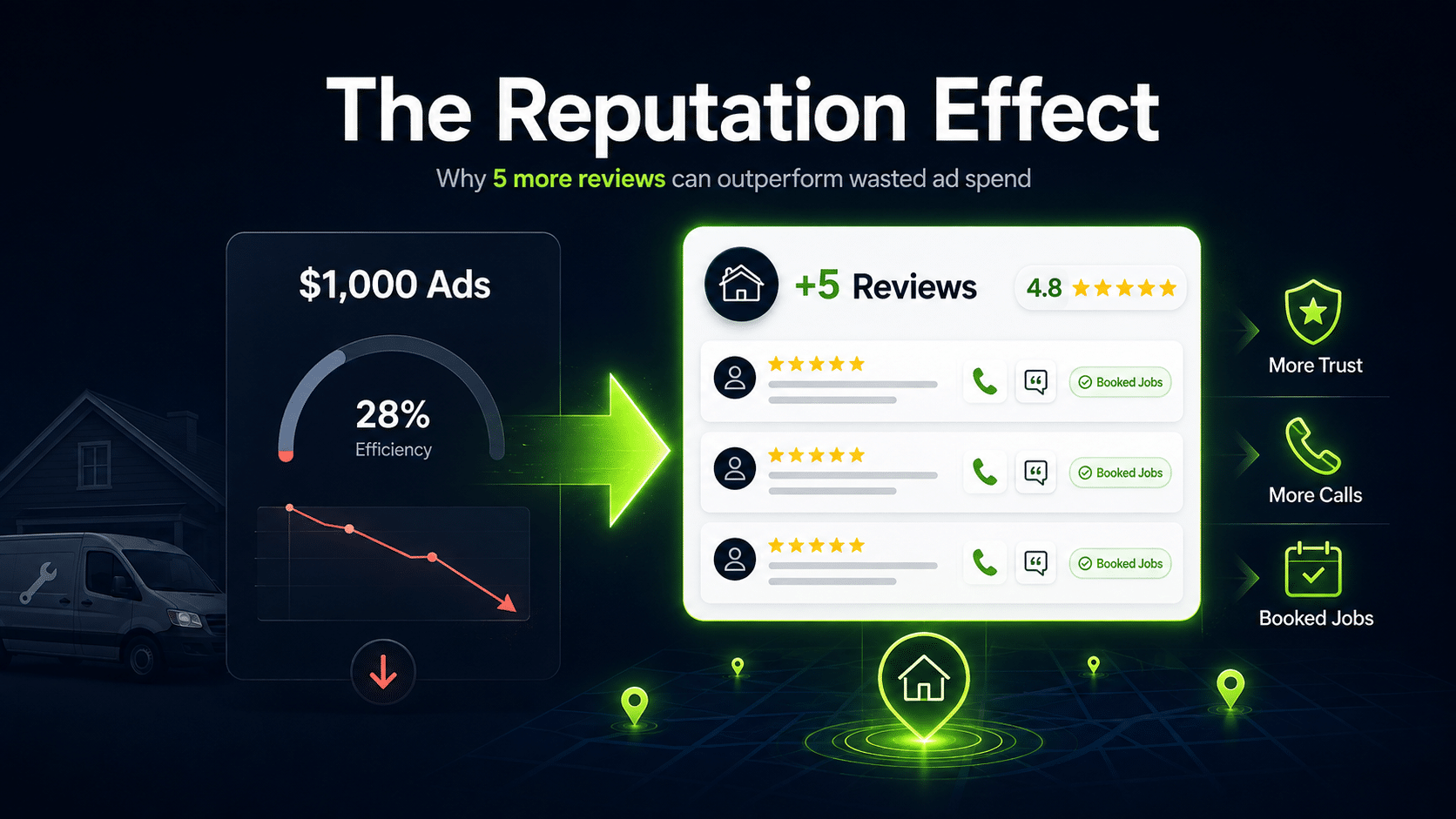
The Reputation Effect: How 5 More Google Reviews Can Outperform $1,000 in Ad Spend
Most home service companies know exactly how much they spend on advertising every month. $1,000. $3,000. $10,000. Maybe considerably more. Ask the same owner how many new Google reviews the...
Read Story
Prompt Farming: The New Keyword Research for Home Services
Here’s a scenario that will change how you think about content forever. Same problem. Same homeowner. Same purchase intent. But watch the difference in how they ask. On Google, they...
Read Story