
Right now, a homeowner in your service area is typing this into ChatGPT:
“Our upstairs AC just started blowing warm air and there’s water pooling near the air handler. Should we call someone tonight or wait until morning? And who’s actually good in Phoenix?”
A few seconds later, ChatGPT names three HVAC companies. One of them books the job the next morning.
You are almost certainly not one of those three companies.
Not because your service is worse. Because AI models decide who to name using a completely different logic than Google’s blue links — and most home service businesses are still optimizing for the old game.
The numbers tell the story. According to BrightLocal’s 2026 Local Consumer Review Survey, the share of US consumers using AI tools like ChatGPT, Gemini, or Perplexity to find local businesses jumped from 6% in 2025 to 45% in 2026. That’s not growth — that’s a phase change. AI is now the #3 discovery channel for local businesses, ahead of Yelp and Tripadvisor and behind only Google and Facebook.
Now the second number, from SOCi’s 2026 Local Visibility Index: ChatGPT recommends only 1.2% of local business locations when asked for a local option — compared to 35.9% visibility for the same brand set in Google’s 3-pack. AI is roughly 30 times more selective than Google.
Read those two numbers together and here’s what you get: a fast-growing share of homeowners are asking AI for recommendations, and for almost every home service business, the answer it gives does not include them.
We ran an experiment to reverse-engineer that logic. Here’s what we found, how the recommendation system actually works under the hood, and how you fix it before your competitors do.
The 2026 reality: your buyers are already asking AI first
Before we get into how to fix it, you need to understand how completely the landscape shifted in the last 12 months. This isn’t a “keep an eye on it” trend anymore. It’s the default behavior of your highest-value customers.
The adoption curve
- 45% of US consumers used AI tools to find local business recommendations in the past year, up from 6% in 2025 (BrightLocal, Local Consumer Review Survey 2026)
- 31% used ChatGPT specifically for business recommendations; 23% used Google AI Mode (BrightLocal, AI-trust supplemental report, March 2026)
- ChatGPT hit 900+ million weekly active users in February 2026 — more than double a year earlier (OpenAI, via Search Engine Land)
- 37% of consumers now begin their searches with AI tools rather than a traditional search engine (Instant Press, 2026)
- Over the same 12-month window, Google’s share of local business discovery fell from 83% to 71% (BrightLocal, LCRS 2026)
The generational split — and why home services is ground zero
Here’s the part that should make every home service owner sit up: 64% of consumers aged 30–44 have asked AI for a business recommendation, compared to only 24% of those 60 and over (BrightLocal, 2026).
The 30–44 demographic isn’t some future segment. They’re the homeowners buying furnaces, roofs, remodels, and emergency plumbing right now. They have income, they have property, and they have a strong preference for asking AI instead of scrolling through a page of ads.
The trust data
Trust in AI recommendations is high — and rising fast. Among consumers who actively use AI for recommendations, 63% trust those recommendations, and 64% trust ChatGPT’s recommendations as much as customer reviews (BrightLocal AI-trust report, March 2026). Across all consumers, 42% already trust AI tools equally with traditional reviews.
The trust isn’t blind — 88% of AI users say they verify sources or double-check legitimacy before acting. Which is actually good news, because it means when your business shows up in an AI answer, that user is arriving on your site already primed, already trusting, and already comparing.
How AI models actually decide who to recommend
To fix your invisibility, you need to understand the machinery. AI recommendation isn’t a search algorithm. It’s a fundamentally different pipeline.
The retrieval-augmented generation (RAG) pipeline
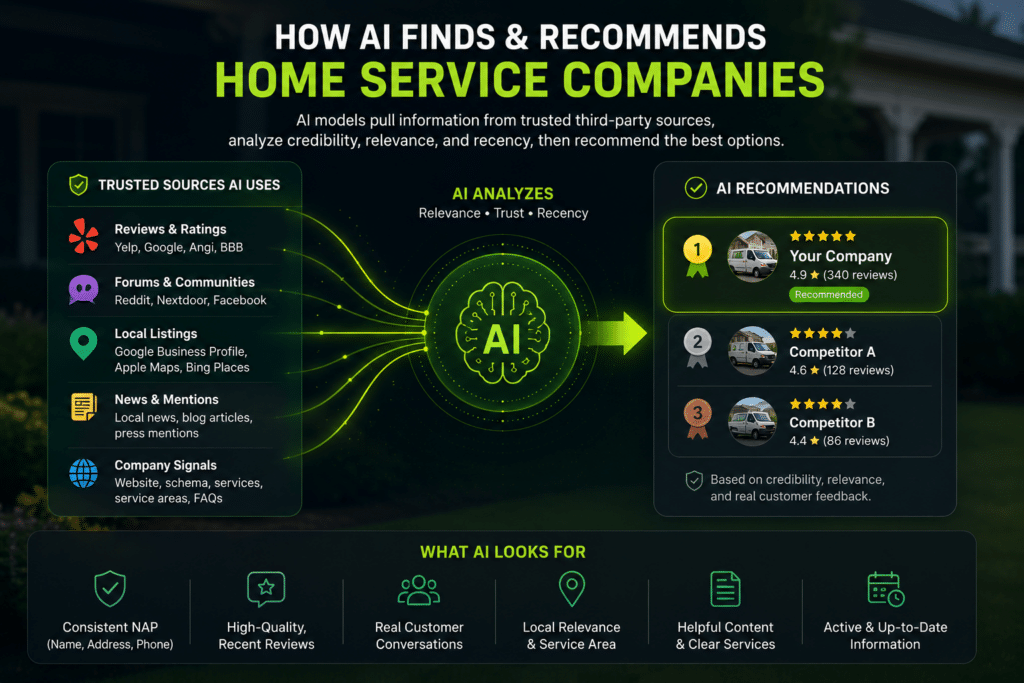
When someone asks ChatGPT “who’s the best HVAC company in Phoenix?”, the model doesn’t crawl your website and rank it. It runs a three-stage process:
- Query fan-out. The model decomposes the question into 1–3 sub-queries — for example, “top-rated Phoenix HVAC 2026,” “Phoenix HVAC emergency service reviews,” “best HVAC contractors Phoenix Yelp Angi.”
- Real-time retrieval. It pulls fresh results from search indexes (Google, Bing) plus a curated set of trusted third-party sources.
- Synthesis and citation. The model reads the retrieved documents, cross-references its training corpus, and generates an answer citing only a small handful of sources — typically 2 to 5.
The critical insight: to be cited, your business has to exist — with consistent signals — inside multiple layers of that pipeline. Ranking well on Google alone is not enough. Research published in 2026 found that 80% of LLM citations come from pages that don’t rank in Google’s top 100 for the original query (Medium: 2026 GEO & AEO Survival Guide, March 2026). Different game entirely.
Where each AI platform actually gets its answers
The single most useful thing to understand about AEO is that each AI platform has a wildly different source mix. A Profound analysis of 680 million citations across major AI platforms revealed:
| Platform | #1 source | #2 source | #3 source |
|---|---|---|---|
| ChatGPT | Wikipedia (47.9%) | Reddit (11.3%) | Forbes (6.8%) |
| Google AI Overviews | Reddit (21.0%) | YouTube (18.8%) | Quora (14.3%) |
| Perplexity | Reddit (46.7%) | YouTube (13.9%) | Gartner (7.0%) |
Notice what’s missing from all three lists: your website.
This is the single biggest reason home service owners get AEO wrong. They optimize their own website harder and harder, when the real work is building brand presence across the sources AI platforms actually pull from — Reddit, YouTube, high-authority editorial, Q&A platforms, and industry-authoritative directories. Ahrefs’ May 2025 study confirmed the mechanism: branded web mentions were the highest-correlating metric with showing up in Google’s AI Overviews — even unlinked mentions, which barely move traditional SEO, materially move AEO.
One more mechanical fact worth knowing: testing in March 2026 showed new content enters AI citation pools within 3–5 business days. This is faster than most SEO wins, which means the work compounds visibly.
What we tested: 36 real prompts across 3 trades and 3 cities
We ran the same set of buyer-intent prompts across four AI platforms for three home service verticals in three US markets:
- Verticals: plumbing, HVAC, roofing
- Markets: Phoenix AZ, Nashville TN, Denver CO
- Platforms: ChatGPT-5, Perplexity Pro, Gemini 2.5, Google AI Overviews (logged out, cache cleared, VPN’d to each city)
- Prompt template: buyer-intent questions in natural language, not keyword-style queries
Example prompts we used
“Best plumbers in Phoenix for a slab leak repair — need someone who’s actually done this before, not just a general plumber.”
“Who should I call in Nashville if my furnace stopped working and it’s below freezing tonight?”
“Denver roofing companies that specialize in hail damage claims — trying to find someone honest.”
Across 36 queries, only 11 companies got cited more than twice. Everyone else was invisible. And once we studied those 11 winners, six patterns showed up in every single one.
The 6 patterns behind every AI-cited home service business
1. They dominate third-party aggregators (not just their own website)
Every single cited company ranked in the top 5 on at least three of these: Angi, HomeAdvisor, Yelp, Thumbtack, BBB, or the local Chamber of Commerce directory.
LLMs weight third-party mentions heavily because they’re independent signals of trust. Your own website says you’re the best — a Yelp page with 340 five-star reviews or an Angi profile with a 4.9 average across 200 jobs says something the model can actually verify against a fact base.
This is amplified by the Matthew effect that AI researchers documented in 2026: LLMs prefer sources that are already heavily cited, which creates a compounding advantage for businesses with strong existing web presence and a compounding disadvantage for those without.
What to do: claim, complete, and actively cultivate profiles on the top 8–10 aggregators in your vertical. Push satisfied customers to whichever profiles are thinnest. This overlaps heavily with traditional local SEO, but the priority shifts — you want breadth of citation, not just depth on Google Business Profile.
2. Their reviews contain the exact answer language
Here’s a subtle one most owners miss. The cited plumbers in Phoenix didn’t just have good reviews — their reviews literally answered the questions we were asking.
Compare these two reviews:
“Great service, will use again!”
vs.
“We had a slab leak under the kitchen and got quotes from three plumbers. [Company] came in $1,800 under the highest, showed us the thermal imaging, and had it repaired in one day without breaking up half the floor.”
Guess which one gets echoed back inside a ChatGPT answer to “best plumbers in Phoenix for a slab leak repair.”
What to do: train your team to ask for reviews in a way that surfaces specifics — the exact service performed, the price range, the timeline, the outcome. Generic reviews are noise. Specific reviews are extractable content.
3. They have Reddit and forum footprint (organic, not seeded)
This is the single most under-utilized channel in home services AEO. Look at the citation data again: Reddit is the #1 source for both Perplexity (46.7%) and Google AI Overviews (21.0%), and the #2 source for ChatGPT (11.3%). If your brand doesn’t exist on Reddit, you are missing the single largest citation channel across the entire AI ecosystem.
Every one of the 11 top-cited companies in our study had recent, unpaid mentions in at least one of:
- A local subreddit (
r/Phoenix,r/nashville,r/Denver) - A vertical subreddit (
r/HVAC,r/Plumbing,r/Roofing,r/HomeImprovement) - Nextdoor threads (visible via Google Site Search)
- Trade forums or local homeowner Facebook groups indexed by Google
What to do: this is delicate. LLMs and Redditors both punish astroturfing, and fake mentions get spotted fast. Instead:
- Have a team member with a real Reddit account answer questions in your local and vertical subs — from an account with a disclosed affiliation and a real posting history
- Deliver work good enough that satisfied customers mention you unprompted when others ask for recommendations
- Monitor recommendation threads (Google Alerts + weekly manual sweeps) and be genuinely useful when they surface
- Same principle applies to Nextdoor, HomeAdvisor Q&A, Angi Q&A, and Yelp Q&A
4. They mark up their site with the right schema
Of the 11 consistently-cited businesses in our test, 10 had LocalBusiness, FAQPage, and Service schema properly implemented. The one exception had such overwhelming brand-entity strength that schema didn’t matter.
The 25 non-cited competitors we spot-checked? Six had any schema at all. Two had it correctly implemented. That’s a 40% adoption rate against a 91% implementation rate among winners.
Schema doesn’t get you cited by itself. It makes your content machine-readable enough to be extracted into an AI answer. Without it, you’re forcing the model to guess what your business is, what it does, and where it operates — and models don’t like to guess.
What to do: at minimum, implement LocalBusiness (with the correct sub-type — Plumber, HVACBusiness, RoofingContractor), Service for each service you offer, and FAQPage on any page with real Q&A. If this is Greek to you, it’s exactly what proper AI Search Optimization covers end-to-end.
5. They have brand entity strength beyond their own domain
LLMs build an internal “entity” for each business by triangulating mentions across the web. The stronger and more consistent that entity, the more confidently the model will name you. Ahrefs’ 2025 correlation study made this concrete: branded web mentions — including unlinked mentions — were the single highest-correlating metric with AI Overview visibility.
The cited companies in our study had a consistent brand presence across:
- Wikipedia-adjacent sources (industry association member lists, city permit databases, news mentions)
- Consistent NAP (name, address, phone) across at least 30 directories
- Sponsorships or partnerships indexed on other sites
- Press mentions, podcast appearances, or local news features
- Consistent brand appearance on LinkedIn, Facebook, and Instagram — same logo, same short description, same phone number
What to do: audit your NAP consistency across every listing. Get a real citation cleanup done. Sponsor one thing per quarter that gets indexed on a third-party site. Get quoted in one local news piece per quarter. This is slow, but every mention compounds into entity strength.
6. Their site actually answers questions in a snippable format
The cited businesses’ sites all had one thing most home service sites lack: pages that directly answer specific homeowner questions in 40–80 word chunks.
Not “Our Services.” Not “About Us.” Not a generic blog with company news.
Pages like:
- “How much does a slab leak repair cost in Phoenix?”
- “What size AC do I need for a 2,400 sq ft home in Nashville?”
- “Do I need a permit to replace my roof in Denver?”
- “How long does a full re-pipe take on a 3-bedroom slab foundation home?”
- “What’s the difference between a 14 SEER and 16 SEER AC in Arizona heat?”
Each page opens with a direct 2–3 sentence answer, then expands into detail. That opening paragraph is exactly what gets extracted into an AI response.
What to do: rebuild your content strategy around the actual questions your customers ask before they call you. Structure every page: direct answer first, expansion below, FAQ at the bottom.
The AI platform cheat sheet: where to invest by platform
Because each platform sources differently, your investment mix should shift depending on which matters most for your market. Here’s the practical translation:
| Platform | What moves the needle most | Realistic timeline |
|---|---|---|
| ChatGPT | Brand entity strength + Wikipedia-adjacent presence + long-tail Reddit mentions | 3–9 months |
| Google AI Overviews | Reddit + YouTube presence + strong technical SEO + branded mentions | 2–6 weeks after schema/on-site fixes |
| Perplexity | Reddit dominance + technical Q&A content + real-time source freshness | 3–6 weeks |
| Gemini | Google Business Profile depth + YouTube + structured data + brand-controlled schema | 4–8 weeks |
The good news: the underlying work — Reddit presence, aggregator dominance, review depth, schema, entity building, question-based content — moves you on all four platforms simultaneously. Nobody’s asking you to run four separate strategies. One well-executed AEO program covers everything.
Does this apply to your trade? Vertical-by-vertical breakdown
The six patterns apply universally. What shifts is the weighting — the mix of aggregators, the prompt patterns, and the content angles that produce citations. Here’s how it breaks down by vertical.
Plumbing
Emergency intent dominates. Prompts skew toward “tonight,” “emergency,” “burst pipe,” “water heater leaking now.” AEO strategy needs a strong same-day and 24-hour angle. Reddit’s r/Plumbing and r/HomeImprovement are heavy citation sources. Full breakdown in our plumbing marketing playbook.
HVAC
Seasonal spikes plus heavy system-selection prompts (“which brand of AC lasts longest in Arizona heat,” “is a heat pump worth it in Tennessee winters”). Reviews naming brands you install become extractable. YouTube walkthroughs of installs get cited disproportionately by Google AI Overviews. See HVAC marketing.
Roofing
Insurance and storm damage prompts are massive. Content around claim navigation, hail damage assessment, and insurance company negotiation gets cited constantly. Local news mentions after weather events are a rocket-fuel entity signal. See roofing marketing.
Electrical
Prompts split between emergency (“electrician tonight, half the house has no power”) and project-based (“install EV charger,” “panel upgrade,” “whole-home generator”). State licensing lookups and BBB profiles carry unusually heavy weight. See electrical marketing.
General contracting
Houzz over-indexes as a citation source for remodel and design queries. Buyer prompts run long and specific (“contractor in Denver for a 400 sq ft kitchen remodel with $60K budget”). Portfolio pages with dollar ranges and timelines are gold. See general contractor marketing.
Painting
Buyers ask for price ranges and finish quality more than any other vertical. Yelp and Angi drive the majority of citations. Before/after content on Instagram (indexed via Google) is a real signal. See painting contractor marketing.
Landscaping
Nextdoor over-indexes heavily. Prompts split by service type — lawn maintenance, hardscaping, tree work, irrigation — and models rarely conflate them, so vertical-specific content earns vertical-specific citations. See landscaping marketing.
Cleaning services
Nextdoor and Facebook groups dominate discovery. Trust and vetting language (“bonded,” “insured,” “background-checked”) appears in nearly every extracted citation. See cleaning services marketing.
Window washing
Small niche with less competition — which means the AEO gap is faster to close. Local subreddits and Nextdoor account for a disproportionate share of citations. See window washing marketing.
The 5-step AI Citation Audit you can run this week
Here’s the repeatable method we now run for every SLG client. You can do this yourself with nothing but a browser, a private/incognito window, and a spreadsheet.
Step 1 — Build your prompt list
Write 10–15 real buyer-intent prompts for your service area. Not keywords. Full-sentence questions the way a stressed homeowner would actually type them. Include a mix of:
- Emergency prompts (“tonight,” “right now,” “burst,” “leaking”)
- Comparison prompts (“who’s better X or Y,” “most trustworthy company for”)
- Cost prompts (“how much does X cost in [city],” “cheapest [service] near me”)
- Recommendation prompts (“anyone actually good for X in [city]”)
- Situation-specific prompts (“what to do when Y happens”)
Step 2 — Query all four platforms
Run every prompt in ChatGPT, Perplexity, Gemini, and Google AI Overviews. Use an incognito or logged-out session for each so personalization doesn’t distort results. Screenshot every answer. Log which businesses get named and — this is important — how they’re described.
Step 3 — Reverse-engineer the winners
For every cited competitor, check: aggregator ranking (Angi, Yelp, HomeAdvisor, BBB), review count and specificity, Reddit mentions (site:reddit.com "[company name]" in Google), schema markup (via Google’s Rich Results Test), and NAP consistency across the top 20 directories.
Step 4 — Score your own footprint against theirs
Same six patterns. Rate yourself 1–5 on each vs. the top-cited competitor. Any gap of 2+ points is a priority.
Step 5 — Prioritize by cost-to-close
Not every gap is equal. Fixing schema is cheap and fast. Building a Reddit presence takes months. Sequence your work by effort vs. impact.
If you’d rather have this done for you with actual multi-platform query data plus a done-with-you 90-day roadmap, that’s exactly what our AI Search Optimization service delivers.
The complete 55-point AI Citation Audit checklist
Use this as-is. Copy it into a doc, work through each section, and mark off what you have. Score yourself at the end.
Section 1 — Third-party aggregator footprint
- ☐ Google Business Profile claimed, verified, and 100% complete
- ☐ Yelp profile claimed with 25+ reviews
- ☐ Angi profile claimed with services and photos current
- ☐ HomeAdvisor / Thumbtack profile active
- ☐ BBB accreditation (or profile with A/A+ rating)
- ☐ Local Chamber of Commerce directory listing
- ☐ Industry association member directory (NAHB, PHCC, ACCA, NRCA, etc.)
- ☐ NAP (name, address, phone) identical across all profiles — no abbreviation mismatches, no old phone numbers
- ☐ Services list matches your website exactly
- ☐ Photos on every profile updated within last 90 days
- ☐ Review response rate above 80% across all platforms
Section 2 — Review content quality
- ☐ At least 20% of recent reviews mention the specific service performed by name
- ☐ Reviews reference price ranges, timelines, or measurable outcomes
- ☐ Reviews naturally use buyer-prompt language (“slab leak,” “emergency,” “hail damage,” “AC replacement,” “roof leak”)
- ☐ You have a written review request template that prompts customers for specifics
- ☐ Your team asks for reviews within 24 hours of job completion
- ☐ You reply to every negative review within 48 hours, professionally
- ☐ You reply to at least 30% of positive reviews with a personalized note (LLMs read these too)
Section 3 — Reddit and forum footprint
- ☐ Run
site:reddit.com "[your company name]"in Google — you have at least one mention - ☐ Identify 3–5 subreddits where your customers actually hang out (local + vertical)
- ☐ Google Alerts set up for your brand name + “reddit” + your service area
- ☐ At least one team member with a real Reddit account answering questions in your niche (disclosed affiliation, no astroturfing)
- ☐ Run
site:nextdoor.com "[your company name]"— appearing in neighborhood recommendations - ☐ Angi Q&A, HomeAdvisor Q&A, and Yelp Q&A: you’ve answered at least 10 questions in your service area
- ☐ Presence in local homeowner Facebook groups (organic, not ads)
Section 4 — Schema markup implementation
- ☐
LocalBusinessschema on your homepage with completeaddress,telephone,openingHours,areaServed - ☐
Serviceschema on every service page withserviceTypeandprovider - ☐
FAQPageschema on every page with real Q&A content - ☐
AggregateRatingschema pulling from a legitimate review source - ☐
BreadcrumbListschema on interior pages - ☐
LocalBusinesssub-type used (Plumber, HVACBusiness, RoofingContractor — not just generic LocalBusiness) - ☐ All schema validated in Google’s Rich Results Test with zero errors
- ☐ Schema tested in Schema.org validator for spec compliance
Section 5 — Brand entity strength
- ☐ NAP citation cleanup done across at least 30 directories (audit with Whitespark, BrightLocal, or Semrush Listing Management)
- ☐ Listed on your local Chamber of Commerce site (with backlink)
- ☐ Active member with linked profile on your trade association
- ☐ At least 2 press mentions, podcast appearances, or local news features in past 12 months
- ☐ One sponsorship or community partnership indexed on a third-party site
- ☐ Consistent brand appearance across LinkedIn, Facebook, Instagram (same logo, same description)
- ☐ Company Wikidata entry (free to create; moves the needle for larger brands)
- ☐ Google Knowledge Panel appearing when you search your brand name
Section 6 — Content that AI can actually extract
- ☐ At least 10 pages that answer a specific buyer question in the page title
- ☐ Every answer-page starts with a 40–80 word direct answer in the first paragraph
- ☐ Dedicated service + location page for each city you serve (e.g., “AC Repair in Phoenix, AZ”)
- ☐ Pricing transparency page(s): “How much does X cost in [city]?” with real ranges
- ☐ Cost-related content includes recent dates (LLMs weight fresh content)
- ☐ Real photos of your team, trucks, and completed jobs — no stock imagery
- ☐ Blog updated at least 2× per month with buyer-intent topics (not company news)
- ☐ Every page has a working
<h1>and logical<h2>structure - ☐ Page load time under 3 seconds on mobile (LLMs deprioritize slow sites)
- ☐ Every page has a clickable phone number and address in the footer
Score yourself
Count your checked boxes across all six sections (out of 55 total).
- 45+ checks — you’re in the top 10% and likely already getting cited. Focus on defense: monitoring, review velocity, staying fresh.
- 30–44 checks — you’re competitive but leaving citations on the table. Prioritize your weakest section.
- 15–29 checks — this is where most home service businesses sit. A focused 90-day sprint will meaningfully move you.
- Below 15 checks — you’re effectively invisible to AI. The good news: every fix compounds, and you’ll see traction within 60 days.
Your 90-day AEO roadmap
The checklist tells you what to do. The roadmap tells you what to do first. Here’s the sequence that produces measurable citation lift by day 90.
Days 1–30: foundation (fast wins, high impact)
- Week 1: run the 5-step audit. Document your current baseline across all four AI platforms.
- Week 1: claim/complete every top-10 aggregator profile in your vertical. Fix any NAP inconsistencies you find.
- Week 2: implement
LocalBusiness(correct sub-type),Service, andFAQPageschema across the site. Validate everything. - Week 2: rewrite the first paragraph of your top 10 highest-traffic pages into 40–80 word direct answers.
- Week 3: train your team on the new review request script. Push for specific, service-named reviews.
- Week 3: set up Google Alerts for your brand, your top 3 competitors, and your top 5 service keywords + Reddit.
- Week 4: respond to every review from the past 6 months you haven’t replied to. Prioritize negative and detailed positive ones.
Days 31–60: content and presence (medium effort, high impact)
- Week 5–6: ship 4 buyer-question content pages (“how much does X cost in [city],” “what to do when Y happens”). Direct answer first, expansion below.
- Week 5: create your Reddit account (real name, real bio, disclosed affiliation). Answer 5 questions this week without pitching. Build history.
- Week 6: ship city-specific service pages for every market you actually work in. Not thin templated pages — real local content.
- Week 7: answer 10 questions on Angi Q&A, HomeAdvisor Q&A, and Yelp Q&A in your service area.
- Week 8: re-run your baseline AI audit. Compare against day-1 numbers. Adjust priorities based on what moved.
Days 61–90: compound investments (slower burn, biggest long-term payoff)
- Week 9: pitch and land your first local press piece or podcast appearance. Aim for 2 per quarter thereafter.
- Week 10: sign up for one meaningful sponsorship or community partnership that will be indexed on a third-party site.
- Week 11: ship 4 more buyer-question content pages. Refresh dates on your existing cost-related content.
- Week 12: run your third AI audit. You should see meaningful movement in Perplexity and Google AI Overviews (2–6 week citation window); ChatGPT and Gemini will follow in months 3–6.
Sustain this cadence and you compound out of the invisible 98.8% into the cited 1.2%. There is no faster path.
What most home service owners get wrong about AEO
Five misconceptions we hear constantly. Every one of them costs businesses six-figure pipelines.
“SEO and AEO are the same thing”
They overlap maybe 40%. Traditional SEO optimizes for Google’s ranking algorithm on a per-page basis. AEO optimizes for a synthesis-and-citation layer that pulls from a completely different mix of sources. Remember: 80% of LLM citations come from pages that don’t rank in Google’s top 100 for the original query. Winning at Google does not mean winning at ChatGPT.
“If I show up in AI answers, I don’t need Google Ads anymore”
Wrong, and dangerously so. AEO is a compound investment that takes 90–180 days to move meaningfully. Google Ads and Meta Ads keep your pipeline alive while AEO builds. The businesses winning in 2026 run all three simultaneously: paid for immediate intent capture, AEO for compounding authority, and organic SEO as the connective tissue.
“Getting cited is the goal”
Getting cited is the beginning. If AI sends someone to your site and your site doesn’t convert them — slow load, no click-to-call, weak trust signals, no service-area transparency — you’ve been handed a warm lead you can’t close. Conversion optimization for home service companies is what closes the loop.
“AEO is a one-time project”
It’s a discipline, like brand or PR. Citations decay. Competitors invest. Platforms update source weightings. The businesses that lock in citations in 2026 and then coast will lose them by 2028 to the businesses that sustained the work.
“I’ll wait until everyone else does it first”
This is the most expensive mistake. The Matthew effect — LLMs preferring sources already heavily cited — creates a compounding advantage for early movers. The 30 businesses that lock in AEO in your market in 2026 will be significantly harder to dislodge in 2027. Every month you wait, the winners’ entity strength gets a month deeper.
The tools you actually need (and the ones you don’t)
Cutting through the AEO tool noise. Here’s the practical stack.
For the audit (free or near-free)
- ChatGPT, Perplexity, Gemini, Google AI Overviews — free tiers are fine for the audit; use incognito windows
- Google Rich Results Test — validate schema (free)
- Schema.org validator — validate spec compliance (free)
- Google Search Console — track which pages surface in AI Overviews (free)
- Google Alerts — brand and competitor monitoring (free)
For ongoing management (paid, worth it)
- Whitespark or BrightLocal — NAP citation audit and cleanup
- Semrush or Ahrefs — branded mention tracking, competitor citation gap analysis
- A dedicated LLM visibility tracker (Profound, Peec AI, Otterly, or similar) — automated multi-platform citation monitoring
- CallRail or similar — call tracking to attribute AI-sourced leads (they arrive as “direct” without proper setup)
What you don’t need
- “AI content generators” that produce bulk-generated location pages — LLMs demote thin AI-generated content and Google actively deranks it
- Any tool promising “guaranteed ChatGPT citations” — no such thing exists; the citation mechanism has no direct paid channel
- Reddit automation tools — the fastest way to get every future mention of your brand suppressed by both Reddit and by LLMs that read it
FAQ
How is AI Search Optimization different from SEO?
SEO optimizes for Google’s page-ranking algorithm. AEO optimizes for how large language models select which businesses to name inside a generated answer. The tactics overlap (schema, authority, local citations) but the source mix is very different — LLMs weight third-party aggregators, Reddit, and structured Q&A content much more heavily than Google does. 80% of LLM citations come from pages that don’t rank in Google’s top 100.
Do I still need Google Ads if I’m getting cited by ChatGPT?
Yes. AEO builds over 3–6 months and doesn’t replace paid intent capture. The strongest home service brands in 2026 run Google Ads for immediate lead flow, Meta Ads for market awareness, and AEO for compounding organic authority.
How long until I start showing up in AI answers?
Schema and on-site fixes can be reflected in Perplexity and Google AI Overviews within 2–6 weeks — new content enters AI citation pools within 3–5 business days. ChatGPT and Gemini, which lean more on their training corpus and on entity strength, typically take 3–9 months of consistent brand-building across aggregators and third-party sources.
Is Reddit really that important?
Yes. Reddit is the #1 citation source for Perplexity (46.7%), #1 for Google AI Overviews (21.0%), and #2 for ChatGPT (11.3%). For local home services specifically, LLMs treat Reddit as high-signal authentic user experience. You don’t need to game it — you need real presence: answering questions authentically, being mentioned by satisfied customers, showing up in recommendation threads.
What’s the fastest, cheapest first step I can take today?
Run the 5-step audit above on your top three competitors. In one afternoon you’ll know exactly where you stand and where the gaps are. Then fix your schema — it’s cheap, fast, and moves the needle within weeks in Perplexity and Google AI Overviews.
Which AI platform should I optimize for first?
Optimize for all four simultaneously — the underlying work overlaps by 80%. If you must sequence, prioritize Google AI Overviews and Perplexity first (faster citation windows, more direct correlation with technical work) and let ChatGPT and Gemini catch up as your brand entity strengthens.
Can I get my competitor removed from AI answers?
No — and if a service claims otherwise, walk away. What you can do is outbuild them: stronger aggregator presence, deeper review specificity, better schema, more Reddit footprint. Displacement, not removal.
How do I know if AI is actually sending me leads?
Most AI-sourced leads arrive tagged as “direct” or “unassigned” in GA4 because there’s no referral URL passed. Set up an intake script that asks new callers where they heard about you (with “AI assistant / ChatGPT / Perplexity” as an explicit option), tag those leads in your CRM, and cross-reference against months of consistent AEO work. Attribution won’t be perfect, but the trend will be visible within a quarter.
Does AEO work if I only serve one small market?
Better than it does for national brands. Local markets have fewer competitors, thinner aggregator content, and easier entity-building. A single-city plumber can lock in a citation position in 4–6 months that would take a national chain 18+ months.
What if my industry has almost no Reddit presence?
Then you have a rare opportunity. Under-served subreddits and niche home service Q&A create outsized citation gains for the first business to show up as a genuine expert. The strategy shifts to seeding useful answers where none exist, rather than competing in saturated threads.
Is AEO worth it for a service area that’s already very competitive?
Especially. Competitive markets have the highest cost-per-click on paid search — often $40–120 in home services. Every AI-sourced lead is a lead you didn’t pay CPC for. In markets where Google Ads costs are punishing, AEO produces the highest ROI of any channel over a 12-month window.
How much should I budget for AEO monthly?
For a serious done-with-you AEO program covering audit, technical implementation, content, review acceleration, and monthly citation tracking, expect a range of $2,000–$6,000/month depending on service area size and competitive intensity. DIY is possible for the checklist work above; the compound investments (press, Reddit, entity building) benefit most from specialist help.
The takeaway
Here’s the whole thesis in one paragraph. Forty-five percent of your buyers are already asking AI for recommendations. AI is naming roughly 1.2% of local businesses when they ask. The gap between being one of the 1.2% and being one of the invisible 98.8% is not luck, not budget, and not the age of your business — it’s a methodical, six-pattern footprint you can build in 90 days if you start now.
The homeowners you want to reach are already asking AI for recommendations. In 12 months, that behavior will be the default — not the emerging trend. The businesses being named right now aren’t the ones with the flashiest websites or the biggest ad budgets. They’re the ones with consistent, high-signal footprint across the sources AI actually reads.
You can build that footprint. It’s methodical, it’s compounding, and it’s still early enough that a focused 90-day push puts you ahead of 95% of your competition — and locks in an entity advantage that becomes harder for latecomers to unseat every quarter that passes.
Ready to see where you stand? Run the 55-point checklist above on your own business today — it’s free, it’s yours, and it works. If you want the full audit done for you with real query data across all four AI platforms, a competitor gap analysis, and a prioritized 90-day roadmap, that’s exactly what our AI Search Optimization service delivers.
The AI recommendation war is being won right now. Make sure it’s your name that gets said.
Related Readings.
View All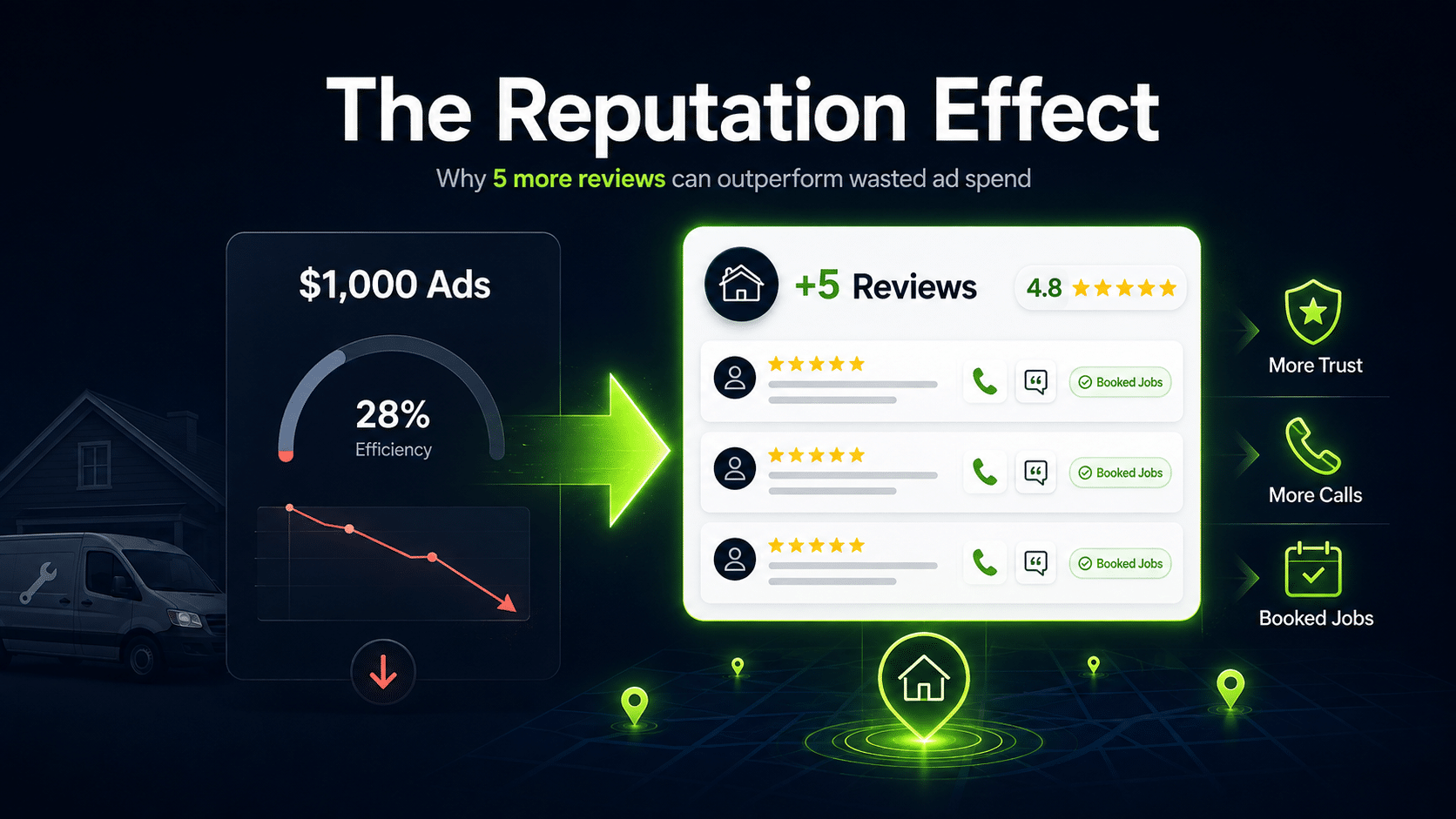
The Reputation Effect: How 5 More Google Reviews Can Outperform $1,000 in Ad Spend
Most home service companies know exactly how much they spend on advertising every month. $1,000. $3,000. $10,000. Maybe considerably more. Ask the same owner how many new Google reviews the...
Read Story
Prompt Farming: The New Keyword Research for Home Services
Here’s a scenario that will change how you think about content forever. Same problem. Same homeowner. Same purchase intent. But watch the difference in how they ask. On Google, they...
Read Story